
In the double-entry system, closing entries are essential for resetting temporary accounts like revenues, expenses, and withdrawals at the end of each accounting period. This process transfers balances to permanent accounts such as retained earnings or capital, ensuring accurate records and preparing the books for the next period. Whether done manually or using software, closing entries help maintain clear and compliant financial reporting. These entries reset temporary accounts to zero, allowing a fresh start for the next accounting period. In accounting, closing entries reset all the temporary accounts to zero and transfer their net balances to permanent accounts.
What’s the Difference Between a Closing Entry and an Adjusting Entry?
You want to avoid the financial confusion of having last period’s numbers overstaying their welcome. Adhering to this order – adjusting then closing – ensures your financial narratives don’t become tangled and that every period’s reporting is as crisp as a freshly printed playbill. All accounts provided on the balance sheet, with the exception of dividends, is permanent. Permanent accounts are accounts that track activities extending over multiple accounting periods. These entries are created to prepare a business for the next accounting period.
Temporary vs. Permanent Accounts
- The expense accounts are now cleared by issuing debits to the income summary account and crediting the expense accounts.
- This follows the rule that credits are used to record increases in owners’ equity and debits are used to record decreases.
- The Retained Earnings account balanceis currently a credit of $4,665.
- Identifying and Recording Transactions and Recording Adjusting Entries are still necessary because that is the original data on which all the other steps are completed.
- The IncomeSummary account has a new credit balance of $4,665, which is thedifference between revenues and expenses (Figure5.5).
- For example, imagine not properly closing revenue accounts at year’s end.
- Having a zero balance in theseaccounts is important so a company can compare performance acrossperiods, particularly with income.
Notice how only the balance in retained earnings has changed and it now matches what was reported as ending retained earnings in the statement of retained earnings and the balance sheet. Welcome to AccountingJournalEntries.com, your ultimate resource for mastering journal entries in accounting. Enhance your accounting skills and knowledge with our comprehensive resources tailored for professionals and students alike. The income-expenditure account of the business organization is related to the corresponding accounting period. This not only saves you time but also gives you peace of mind as you prepare for the next accounting period.
- This is done through closing entries, which close out the revenue and expense accounts to retained earnings.
- Programs like QuickBooks and Xero automate the steps, ensuring accuracy and consistency, which saves time and reduces human error.
- When making closing entries, the revenue, expense, and dividend account balances are moved to the retained earnings permanent account.
- Since the income summary account is only a transitional account, it is also acceptable to close directly to the retained earnings account and bypass the income summary account entirely.
- It also helps the company keep thorough records of account balances affecting retained earnings.
Dividend Accounts and Closing Journal Entries
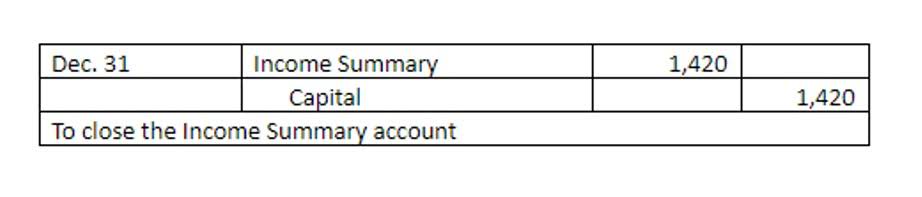
- Now, the income summary account has a zero balance, whereas net income for the year ended appears as an increase (or credit) of $14,750.
- Closing entries, on the other hand, are entries that close temporary ledger accounts and transfer their balances to permanent accounts.
- The first entry requires revenue accounts close to the IncomeSummary account.
- However, it will provide a better audit trail for the accountants who review these at a later point in time.
All of the temporary accounts have now been closed, and at this point the income summary account should have a balance which is equal to the net income shown on Bob’s income statement. To close the account, we need closing entries to debit the revenue account and credit the income summary account. The company can make the closing entry for revenues by debiting all the revenues accounts and crediting the income summary account. As each line of the closing entry is posted to the individual accounts, in the item section of the ledger, a notation is added.
They persist from one accounting period to the next and maintain their balances over time unlike temporary accounts which are closed at the end bookkeeping of the period. These permanent files include assets, liabilities and equity sections making them very useful in showing the company’s financial position that lasts long. Closing entries are journal entries made at the end of an accounting period which transfer the balances of temporary accounts to permanent accounts. Closing entries are based on the account balances in an adjusted trial balance.


You have also not incurred any expenses yet for rent,electricity, cable, internet, gas or food. This means that thecurrent balance of these accounts is zero, because they were closedon December 31, 2018, to complete the annual accounting period. Next, you close the income summary by debiting income summary and crediting retained earnings. Before that, it had a credit balance of 9,850 as seen in the adjusted trial balance above. Unadjusted trial balance – This is prepared after journalizing transactions and posting them to the ledger. Its purpose is to test the equality between debits and credits after the recording phase.
Closing Entries Explained: Key Steps & Examples

At month-end, you close out your expense accounts to the income summary. Notice that the balances in interest revenue and service revenueare now zero and are ready to accumulate revenues in the nextperiod. The Income Summary account has a credit balance of $10,240(the revenue sum). The eighth step in the accounting cycle is preparing closingentries, which includes journalizing and posting the entries to theledger. In this chapter, we complete the final steps (steps 8 and 9) ofthe accounting cycle, the closing process. This is an optional stepin the accounting cycle that you will learn about in futurecourses.

Closing entries are essential in accounting as they ensure the accurate separation of financial activity by resetting temporary accounts and updating retained earnings. And closing entries accounting are used to reset the balances of temporary accounting to zero so they are ready for the next accounting period. Remember the income statement is like a moving picture of a business, reporting revenues and expenses for a period of time (usually a year). First, all the various revenue account balances are transferred to the temporary income summary account. This is done through a journal entry that debits revenue accounts and credits the income summary. By Outsource Invoicing transferring the net income (or loss) and any dividends paid to the retained earnings account, closing entries keep the retained earnings balance up to date.